
Thurston County Sex Offender Checks
The Washington Sex Offender Public Registry, commonly called WASOR, is the first public search channel for a Thurston County sex offender lookup. The Washington Association of Sheriffs and Police Chiefs operates the public interface. County sheriffs maintain and verify the underlying local registration details. Searchers can use a name, an address, a city, a ZIP code, or the Thurston County filter. Map and list views then provide two ways to review public results.
A registry result is only one part of a careful check. Use the Thurston County Sheriff's forms page for local registration forms and the sheriff's office for facts that need verification. Use the court clerk when the filed judgment matters. The registry is a public-safety notice, not the complete court record, and an absence from broad public results does not prove that no registration duty exists.
Thurston County Registry Office
The Thurston County Sheriff's Office is the local registrar. Its administrative headquarters is at 1111 Israel Road SW, Tumwater, WA 98501. The main line is 360-786-5500, and the lobby is open weekdays from 8:30 a.m. to 4:30 p.m., with a noon to 1:00 p.m. closure. Anyone who needs to confirm where to appear should call before traveling because the research does not establish a separate public registration-counter schedule.
State law places the reporting duty on the person who must register. Under RCW 9A.44.130, qualifying residents register with the sheriff where they live. A qualifying nonresident may also have to register in the county where that person attends school, works, or carries on a vocation. Many arrivals and changes trigger action within three business days. A person with no fixed residence must report in person each week on the weekday set by the sheriff.
The sheriff publishes an Offender Information Update form, Registration Requirements materials, and a Petition to Be Relieved form. These documents help registrants follow the official process. Members of the public should use the registry's tip or correction control, or contact law enforcement, instead of trying to enforce a duty themselves.
Washington Sex Offender Public Registry Searches
WASOR supports both person and place searches. Start narrowly when the spelling is known. Use geographic tools when the question concerns an address or nearby area. The interface is dynamic, so its live radius choices may change. Do not assume a radius value that is not shown on the current form.
- Open WASOR and review the site's conditions for lawful use.
- Enter a first and last name, or choose address, city, ZIP, and Thurston County location fields.
- Run the search, then compare map and list results without treating a similar name as a confirmed identity.
- Open the relevant public profile and read its risk, offense, address, and compliance fields in context.
| Field or Control | Type | Required | Use |
|---|---|---|---|
| First and last name | Text | No | Search by optional name parts, with surname as the main identifier |
| Address, city, ZIP | Text | No | Run a place or proximity search |
| State | Fixed or dropdown | As shown | Keep the search within Washington |
| County | Dropdown | No | Select Thurston for county results |
| Radius | Dropdown | No | Use only the live values displayed by WASOR |
| Map or list | View control | No | Switch between spatial and row-based results |
WASPC's registry information page shows how Washington describes risk levels and public notification.
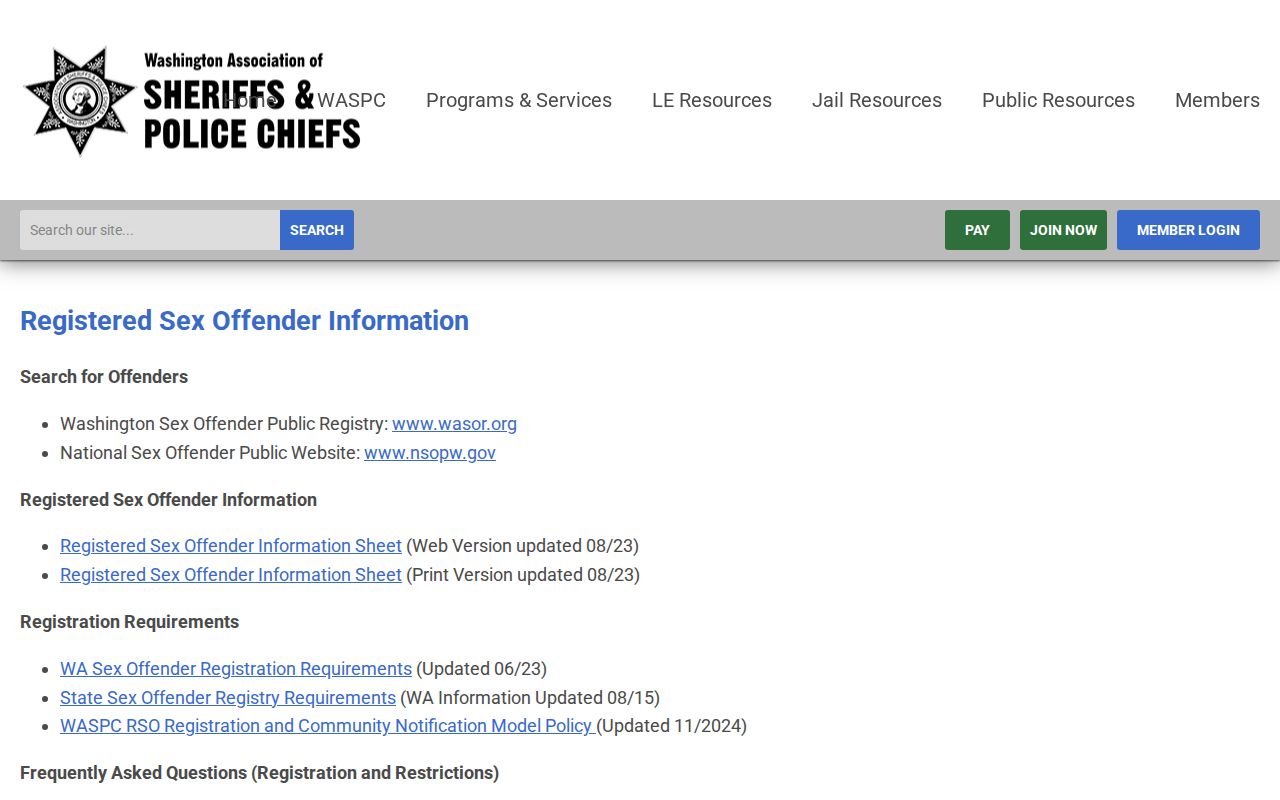
The screen helps separate the public search interface from the rules that control what information is released.
Thurston County Cross-State Checks
WASOR is the primary channel for Washington records. The Dru Sjodin National Sex Offender Public Website, or NSOPW, is useful when a name or address question may extend beyond Washington. It searches participating jurisdictions through one national interface. That breadth matters near state lines or when a person has lived in more than one state.
The national service does not replace local confirmation. Data still comes from participating jurisdictions, and release rules differ. If NSOPW points to a Washington entry, return to WASOR and the Thurston County Sheriff's Office for the local public record. If the issue is a filed conviction or sentence, the relevant court clerk holds the source case file.
The official NSOPW search presents the national layer used for cross-state registry questions.
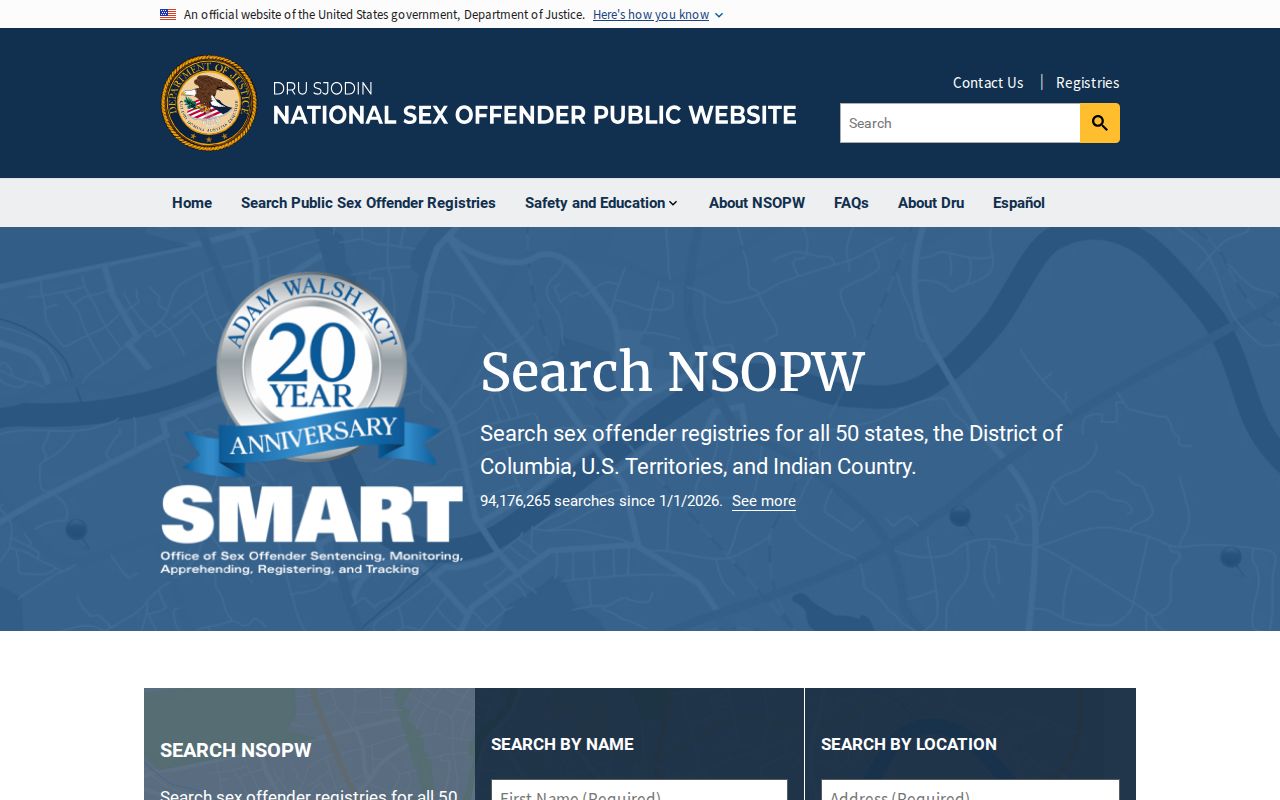
Its value is reach across jurisdictions, while county and state offices remain the best sources for verification.
Note: A missing broad public result does not establish that no protected law-enforcement record or registration obligation exists.
Registry Profiles: What They Show
A public profile can supply enough detail to distinguish records and support community awareness. It does not tell the whole story of the prosecution, and it may not expose every field held by the registrar. Compare names and physical details with care. Read risk level, compliance, address information, and offense data as separate facts.
| Name and aliases | Legal name plus releasable alternate names used to identify the correct record |
|---|---|
| Photo and descriptors | Photo, sex, race, height, weight, hair, eyes, and age or birth information at the authorized level |
| Location | Residence or address detail at the level Washington law permits, plus other releasable locations |
| Offense details | Offense, jurisdiction, date, and statute when the profile supplies them |
| Risk and compliance | Washington risk level, registration status, and compliance information shown by the source |
| Identifying details | Scars, marks, tattoos, or vehicle information when included for public identification |
| Tip or correction | A direct control for sending factual information to the proper authority |
Washington also collects registrar information that is not necessarily public, including fingerprints and a Social Security number. The fact that an agency holds those fields does not permit anyone else to reproduce them. Vehicle or tattoo details shown publicly serve identification and notification, not confrontation.
Thurston Registry Risk Versus Term
Risk level and registration length answer different questions. Washington Level I, II, and III labels describe assessed risk and the reach of community notification. Registration duration instead turns on the conviction category, qualifying prior convictions, and qualifying years in the community. Federal SORNA tiers do not replace Washington's risk-level scheme.
A Level II or Level III label alone cannot tell a reader whether the term is ten years, fifteen years, or indefinite. The same caution works in reverse. A statutory duration does not determine how broadly the sheriff may notify the public. Read both fields, then consult the governing statute when the legal term matters.
- Risk level
- A Washington assessment used to guide the range of community notification.
- Registration term
- The period set by conviction category, prior qualifying history, and time in the community.
- Compliance
- Whether current reporting duties appear satisfied, a distinct issue from both risk and duration.
Registration Levels and Duties in Washington
Under RCW 4.24.550, public notice grows with assessed risk. Level I information generally has limited release to law enforcement and specified recipients, subject to exceptions. Level II notice may reach schools, child-care providers, neighbors, groups, and people likely to encounter the registrant. Level III authorizes broad public notification. A sexually violent predator falls within a separate civil framework and broad notification.
| Washington category | Public-notification treatment | Registration duration |
|---|---|---|
| Level I | Lowest assessed risk; usually limited disclosure, subject to legal exceptions | Not set by level |
| Level II | Moderate risk; notice may reach likely-to-encounter people and groups | Not set by level |
| Level III | Highest assessed risk; broad public notice is authorized | Not set by level |
| Sexually violent predator | Broad notice under a separate civil framework | Depends on the controlling legal framework |
RCW 9A.44.140 separately provides general terms. An adult Class A conviction, or a qualifying prior registration conviction, can mean an indefinite term. A Class B conviction without a qualifying prior generally requires fifteen consecutive qualifying community years. A Class C or specified offense without a qualifying prior generally requires ten. Juvenile post-2023 categories are generally two or three years depending on offense and age, so the statute must be checked for the precise case.
Correct Thurston County Registry Data
A profile's Submit a Tip or Correction control is the right route for a possible error or suspected noncompliance. State what was observed, keep the report factual, and let the agency assess it. Do not post allegations elsewhere or try to question a listed person. For a Washington registration issue tied to Thurston County, the sheriff is the local registrar.
The Thurston County forms page documents the local update route. Its registration and update materials show the official forms available through the Support Services Bureau.
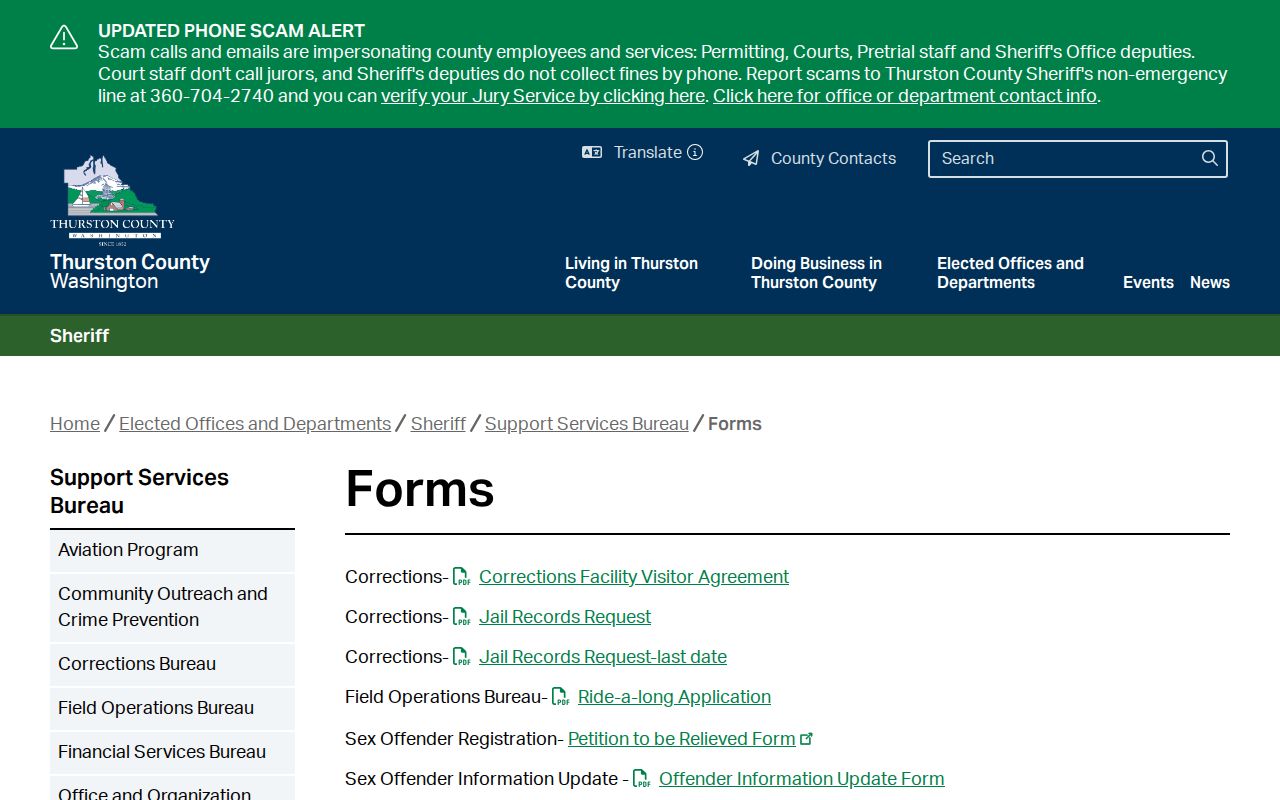
That local channel matters because public users cannot change a registry record themselves, and a profile may need sheriff review before any correction appears.
Thurston Registration Change Deadlines
Washington's reporting clock can be short. Many changes or arrivals require action within three business days. The duty may cover a complete residence, planned places of stay, school, workplace, or vocation details, depending on the person's status. Someone without a fixed residence must report weekly in person and account for places stayed.
These deadlines belong to the registrant and law enforcement. A neighbor or other member of the public should not try to monitor compliance or demand proof. Use the profile reporting control or the Thurston County Sheriff's Office if there is a concrete concern. In an emergency, contact emergency services.
Note: Call the sheriff before an in-person visit because a dedicated registration-counter schedule was not confirmed in the official research.
Using Registry Information Lawfully
Washington makes selected registry information public to support awareness and reasonable safety planning. Community notice is risk-based. It is not permission to threaten, shame, follow, confront, or damage the property of a listed person, family member, or other associated person. An offense label also does not reveal the full judgment, victim facts, or current conduct.
WASPC warns that vandalism, threats, or violence against a registrant, family member, or associated person may lead to prosecution. Verify key details with the originating public office. If a filed judgment is needed, use the County Clerk's case instructions and the site's Thurston County court case lookup routing rather than drawing legal conclusions from the registry profile.
Misuse is unlawful: RCW 4.24.550 authorizes community notification for public safety. Threats, harassment, vandalism, or violence based on registry data can lead to arrest and prosecution.